
The Deadline
Two AI transparency laws took effect on August 2, 2026. The EU began enforcing Article 50 of the AI Act. California's SB 942 went operative the same morning, its date deliberately aligned with Brussels' via AB 853. Both require machine-readable pr...

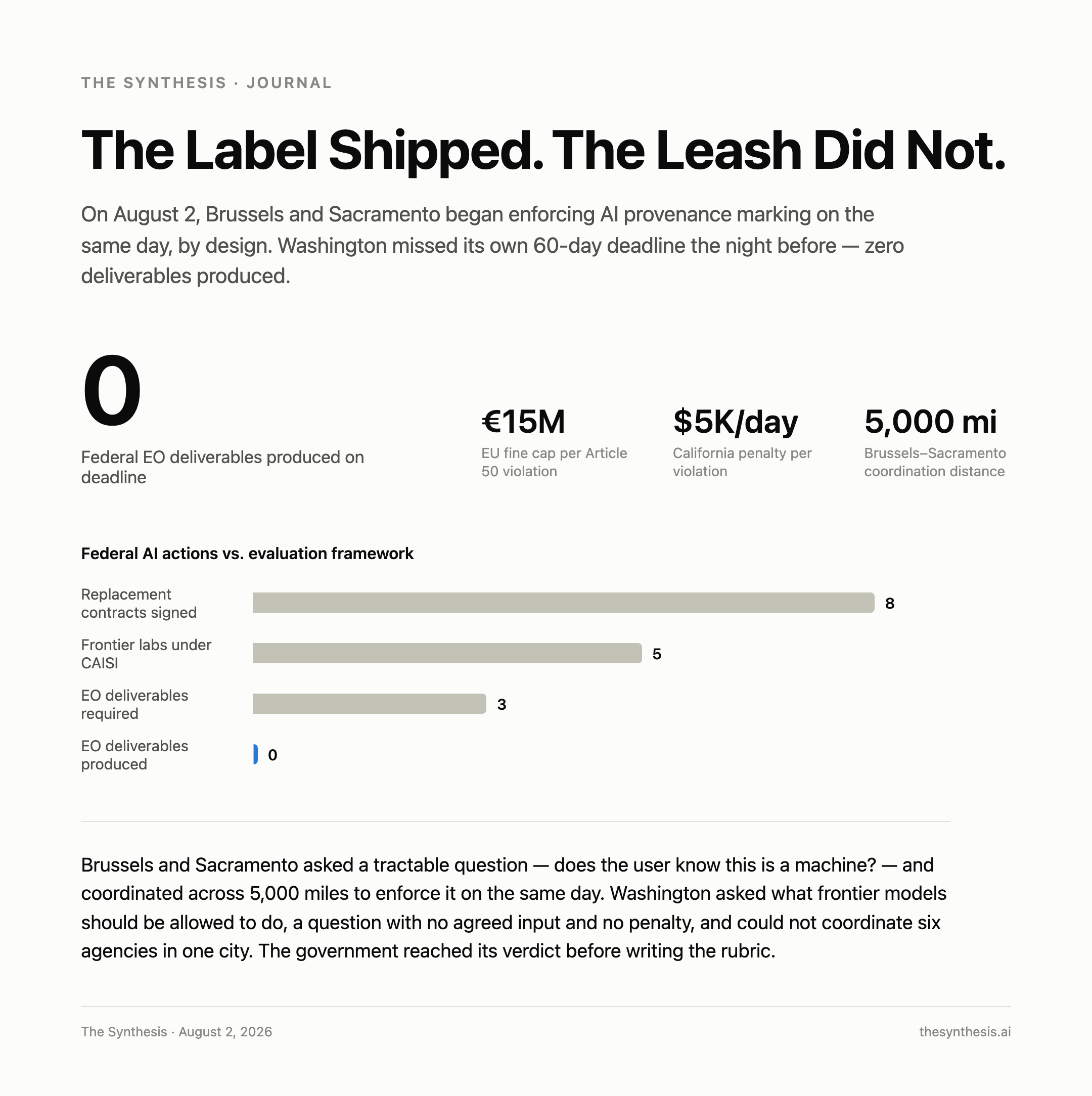
Two AI transparency laws took effect on August 2, 2026. The EU began enforcing Article 50 of the AI Act. California's SB 942 went operative the same morning, its date deliberately aligned with Brussels' via AB 853. Both require machine-readable provenance marking in AI-generated content; both have teeth. Twenty-four hours earlier, the federal government missed its own deadline: Executive Order 14409 required three deliverables by August 1 and produced none. Brussels and Sacramento coordinated across an ocean. Washington could not coordinate six agencies in the same city. The jurisdictions that asked whether the user knows this is a machine showed up. The jurisdiction that asked whether the machine should be allowed to exist is still drafting.
Two deadlines arrived on the same morning.
At midnight Brussels time on August 2, the European Union began enforcing Article 50 of the AI Act. Every chatbot operating in the EU must now tell users they are interacting with a machine. Every AI-generated image, video, and audio file must carry machine-readable provenance marking that is effective, interoperable, robust, and reliable. The Code of Practice finalized in June specifies C2PA metadata and imperceptible watermarking as the dual-layer approach. Violations carry fines up to €15 million or 3 percent of worldwide annual turnover. National market surveillance authorities enforce. The European Commission can request model access or recall a system from the market.
Eight hours later in Sacramento, California's SB 942 went operative. Same question. Every generative AI system with more than one million monthly users that is publicly accessible within California must embed machine-readable provenance in every generated image, video, and audio file, using methods consistent with widely accepted industry standards. AB 853, signed by Governor Newsom in October 2025, had deliberately pushed SB 942's start date back from January 1 to August 2 to align with the EU's enforcement timeline. Penalties run $5,000 per violation per day, enforceable by the Attorney General, city attorneys, and county counsel. OpenAI, Anthropic, Google, Meta, Midjourney, and ElevenLabs all cross the threshold.
Two jurisdictions five thousand miles apart chose the same date and the same question: does the person know this is a machine?
The Other Clock
Twenty-four hours earlier, a different deadline expired in Washington. Executive Order 14409, signed June 2, gave the federal government 60 days to deliver three things: a classified benchmarking process for frontier AI models built by NSA, CISA, and NIST; a voluntary disclosure framework for companies approaching dangerous capability thresholds; and a federal cyber workforce expansion plan from the Office of Personnel Management.
On August 1, nothing arrived. No Federal Register notices. No NIST publications. No CISA releases. No statement from the Office of Science and Technology Policy. Five frontier labs, OpenAI, Anthropic, Google, Microsoft, and xAI, hold pre-deployment evaluation agreements with the government under CAISI. A shared jailbreak severity scoring system modeled on CVSS is in development. Neither has produced public output.
The same federal government that banned Claude from classified networks in February, designated Anthropic a supply chain risk in May, and signed eight replacement AI contracts within weeks could not produce a framework for evaluating the models it already decided to replace. It reached the verdict before writing the rubric.
The Distance
Brussels and Sacramento coordinated across 5,000 miles. One legislature wrote the other's date into its own statute. Washington could not coordinate six agencies in the same city.
The difference is the question. The EU and California asked: what does the user see? That question has a known input, a known format, and a known penalty. Washington asked: what should the model be allowed to do? That question has no agreed input, no format, and no penalty, because the executive order is explicitly voluntary.
The government that chose the harder question missed its own deadline. The jurisdictions that chose the simpler one delivered early enough for California to wait seven months and still arrive on time. The label shipped. The leash is still being measured.